How Teachers Can Assign and Track Daily Homework Without School Diary Confusion
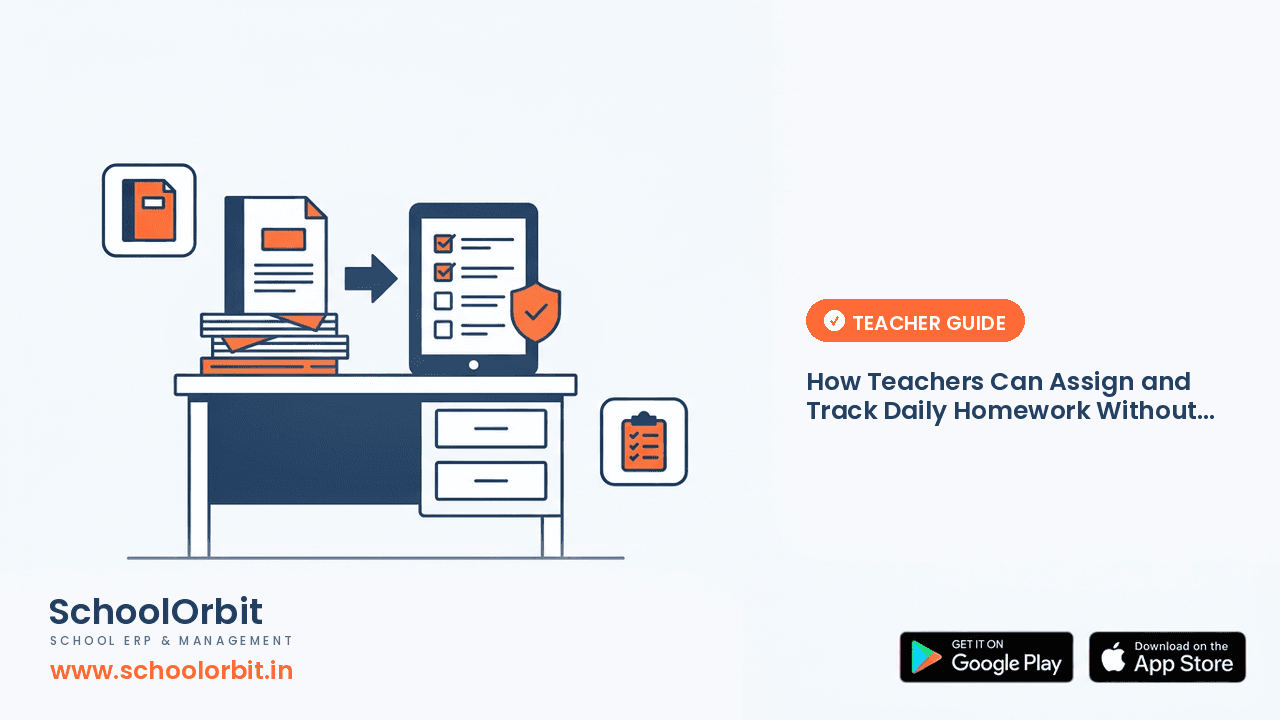
At 1:45 PM, just before the final bell, a subject teacher quickly writes homework questions on the chalkboard. Forty students scramble to copy the instructions into their physical school diaries before the bell rings. By the time students reach home, several have written down the wrong page numbers, two missed the questions entirely, and parents begin calling classmates to confirm what was actually assigned.
The Everyday Frustrations of Chalkboard Homework
Assigning daily homework seems straightforward, but in a busy Indian school day, the process often breaks down between the classroom blackboard and the student study desk at home:
- ✓Rushed copying at the bell: Subject teachers often have only the final two minutes of a 40-minute period to write down homework tasks while packing their teaching materials.
- ✓Incomplete diary notes: Younger students frequently copy partial questions, miss submission dates, or confuse textbook exercise numbers.
- ✓Information gaps for absent students: When a child is absent due to illness, they have no direct way to know what was taught or assigned without relying on friend networks.
- ✓Evening parent confusion: Unclear diary notes lead to anxious parents sending messages to unofficial chat groups late in the evening, asking what needs to be completed.
When homework communication is unclear, students show up unprepared the next morning, and teachers spend the first ten minutes of the period sorting out who missed the assignment and why.
Four Classroom Habits That Bring Clarity to Homework
Before looking at digital tools, adopting a few structured habits during the teaching period can significantly improve how students record their daily work:
- 1Write homework instructions at the start or midpoint of the lesson. Putting the assignment on a designated corner of the board early gives students sufficient time to copy it neatly rather than rushing during the final bell.
- 2State exact expectations and references. Instead of writing 'Do Chapter 4 questions', write 'Answer questions 1 to 5 on page 58 in your science notebook. Do not copy question text.' Precise instructions eliminate guesswork.
- 3Use a classroom homework monitor routine. Assign a responsible student in each row or section to quickly verify that row-mates have copied the correct diary entry before the period ends.
- 4Coordinate with fellow subject teachers. When students face heavy tests or multiple project deadlines on the same evening, learning quality drops. Quick coordination between class teachers and subject specialists prevents homework overload.
How Digital Homework Sharing Replaces Diary Guesswork
While blackboard habits help, physical school diaries have permanent limitations. Digital homework sharing connects teachers, students, and parents with structured clarity:
- ✓One clear broadcast: The teacher posts the assignment details once. The topic, detailed instructions, and exact submission due date appear directly on the student and parent app.
- ✓Instant visibility for absent students: Children recovering at home can review daily classwork and assigned practice without bothering classmates or falling behind.
- ✓Digital attachments and worksheets: Teachers can attach reference PDFs, practice sheets, or reading material directly to the task, saving paper photocopying and printing costs.
- ✓Submission tracking without notebook hunting: Teachers can quickly mark who turned in their work and identify pending submissions without spending twenty minutes flipping through physical notebooks during class.
Best Practices for Managing Submissions and Corrections
Collecting and checking homework efficiently requires clear boundaries and predictable routines:
- 1Set consistent submission windows. Tell students exactly when homework is collected, such as during the morning attendance period or at the start of the specific subject period.
- 2Focus corrections on common errors. Instead of writing identical notes in forty individual notebooks, spend five minutes reviewing the two most common problem areas on the board with the whole class.
- 3Encourage independent work. Remind parents that homework is meant to practice what was learned, not to test perfection. Unfinished homework helps teachers identify who needs extra classroom support.
- 4Acknowledge consistent effort. Simple, timely acknowledgement of neat and regular homework builds study discipline far better than penalising delayed work after the fact.
Homework should reinforce concepts taught in class, build independent study habits, and provide insight into student comprehension. When instructions are clear, students can work with confidence and parents remain supportive partners rather than stressed tutors.
How SchoolOrbit Fits In
SchoolOrbit includes a dedicated Homework module designed for Indian schools. Subject teachers can post daily assignments with subject tags, written guidelines, and attachments in under a minute.
Parents and students view the assigned work directly through the SchoolOrbit mobile app, complete with clear submission dates and instructions. Teachers can check off submissions, keep class records organized, and eliminate the daily scramble of rushed blackboard copying and paper diary confusion.
Quick Homework Checklist for Teachers
- ✓Are homework tasks written down before the final period bell?
- ✓Do instructions clearly specify textbook pages, exercise numbers, and notebook requirements?
- ✓Can absent students access assignments without relying on peer phone calls?
- ✓Have you coordinated with other subject teachers to avoid assignment overload?
- ✓Is there a consistent routine for checking submissions and addressing common mistakes?
Looking to simplify daily homework and parent updates for your school?
SchoolOrbit helps Indian schools manage homework, daily attendance, examination records, and parent communication on one dependable platform.
Important Note
The information in this article is provided for general informational and educational purposes only. It is not legal, financial, regulatory or professional advice, and it should not be relied on as a substitute for consulting qualified professionals or your own advisers.
SchoolOrbit is an independent software provider. We are not affiliated with, endorsed by, or acting on behalf of CBSE, CISCE, any State Board, or any government or regulatory authority, and nothing in this article represents the views of any such body.
Board rules, examination policies, fee regulations and government schemes change from time to time. Always confirm current requirements with the official source — for example cbse.gov.in, cisce.org, your State Education Department, or the relevant government portal — before acting on anything you read here.
Feature descriptions refer to SchoolOrbit’s own software. We do not guarantee any specific outcome, saving or result.
Found an error? Email us at info@schoolorbit.in and we will correct it. See also our Terms and Privacy Policy.