Student Attendance Management System: Best Practices and Automation for Indian Schools
Introduction: Why Daily Attendance Is a Critical School Workflow
Attendance is the primary legal, operational, and pedagogical record maintained by every school in India. According to official Ministry of Education UDISE+ data, India's school network serves 24.72 crore students across 14,66,682 institutions. Every single morning, teachers across the nation perform the same ritual: opening a physical attendance register, calling out names or roll numbers, and penning markers into paper grids.
While traditional, this manual routine comes at a substantial operational cost. Calling roll manually consumes 10 to 15 minutes of the critical first morning period across every classroom. For a medium-sized school with 30 sections, that equates to thousands of lost instructional hours over an academic session. More critically, paper registers delay communication with parents when a student is absent, create massive month-end clerical burdens, and leave institutions vulnerable to compliance failures.
Implementing an automated student attendance management system—integrated within a broader school ERP software framework—transforms attendance from a passive administrative chore into an active student safety and academic monitoring system.
Regulatory Imperative: The CBSE 75% Attendance Requirement
For affiliated institutions, student attendance is not merely an internal metric; it is a statutory board requirement. Under Rules 13 and 14 of the CBSE Examination Bye-Laws, candidates in Class X and Class XII must have put in at least 75% of the attendance in the classes held, counted from the day teaching of the class commenced up to the 1st of the month preceding the month in which the board examination commences. Where a subject involves practical work, at least 75% attendance in the practicals is also required.
The bye-laws establish clear conditions regarding attendance shortages:
- ✓Condonation Limits: Shortage of attendance up to a maximum of 15% may be condoned only by the Chairman of CBSE, and only in respect of candidates appearing for the Class X and Class XII board examinations.
- ✓Strict Grounds for Condonation: Condonation is considered only on the grounds set out in the bye-laws and supported by documentary evidence. Candidates whose attendance falls below 60% are considered only in exceptional circumstances, on serious medical grounds.
- ✓Fixed Procedural Deadline: Shortage cases must reach the candidate's CBSE Regional Office by 7 January of the academic session, and the Board does not accept them after that date.
Under manual paper-register tracking, school principals and academic coordinators frequently discover that a student is falling short of 75% attendance in late December or January, when the List of Candidates (LOC) is finalized. At that stage, there is virtually no remaining instructional time for the student to recover the deficit. An automated system flags students dipping below 80% or 75% dynamically in August, September, and October, enabling timely academic counseling and parental interventions.
Limitations of Traditional Paper-Based Attendance Registers
Paper attendance registers have been a fixture of Indian classrooms for generations, but their structural weaknesses become glaring in modern school operations:
- ✓Delayed Child Safety Communication: If a student leaves home in the morning but does not reach school—due to missing transport or bunking—a paper register holds that information silently in the classroom. Parents remain unaware until evening, creating an unacceptable child security vulnerability.
- ✓Clerical Burden on Teachers: At the close of every month, class teachers must spend valuable hours tallying total working days, days attended, leaves sanctioned, and percentages for each student, taking time away from lesson planning and teaching.
- ✓Physical Damage and Record Integrity Risks: Paper registers can be damaged by water or ink spills, lost during campus transfers, or altered without authorization, exposing the institution to legal and audit liabilities.
- ✓Inability to Track Period-Wise Electives: In Classes 9 through 12, where students split across specialized elective streams (such as Physics, Accountancy, Political Science, or Computer Applications), single-point morning attendance fails to capture period-level truancy.
Modern Attendance Capture Methods: Selecting the Right Model
Modern educational institutions deploy varied technologies depending on student age groups, campus architecture, and administrative workflows:
1. Teacher Mobile App and Web Portal Capture
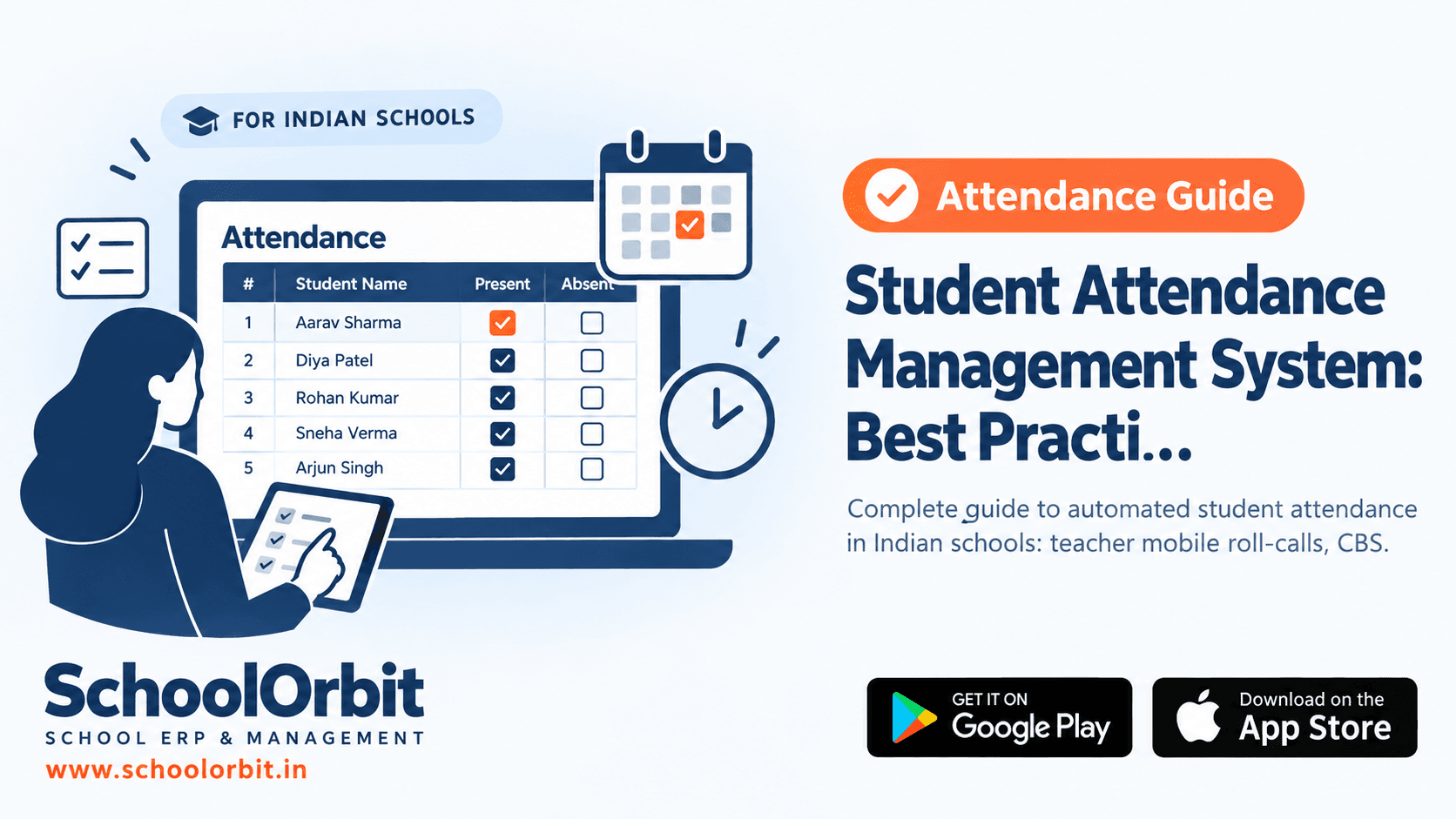
The most widely adopted and practical method in Indian schools is mobile app roll-call by the class teacher. Through an intuitive teacher application, the educator accesses their assigned class roster with one tap. With a "Mark All Present" default, the teacher simply deselects the few students who are absent, completing the entire morning register in under 30 seconds.
2. Subject and Period-Wise Digital Attendance
For senior secondary sections, subject teachers record attendance at the start of each lecture block. This ensures that attendance reflects actual participation in mandatory laboratory experiments, practical sessions, and elective subject hours required for board practical evaluations.
3. RFID Smart Cards and Automated Turnstiles
Equipping student identity cards with RFID chips enables automated tap-in at school entry gates or upon boarding school transport vehicles. While highly effective for campus security and arrival logging, best practice indicates that gate taps should complement rather than entirely replace classroom roll call, ensuring verification of presence in assigned lecture rooms.
4. Biometric and Facial Recognition: Staff vs. Student Considerations
While biometric fingerprint scanners and facial recognition terminals are standard and effective for tracking staff attendance to satisfy board affiliation inspections, their application to students requires caution. Under India's Digital Personal Data Protection Act, 2023, personal data of children is subject to enhanced consent and protective safeguards. Educational institutions must ensure that any student identification technology complies with data minimization principles and parental authorization.
Essential Features of an Enterprise School Attendance System
When selecting a school attendance management system, academic coordinators and school directors should verify that the platform includes the following capabilities:
1. Instant Automated Parent Alerts
The moment a class teacher submits morning attendance, the system triggers automated absence alerts via SMS, WhatsApp, and parent mobile application push notifications. Parents receive immediate confirmation that their child is safely marked present or an urgent notification if marked absent, ensuring complete peace of mind.
2. Online Leave Application and Approval Workflows
Rather than sending handwritten leave notes that often get lost in school bags, parents submit leave applications digitally through the school mobile app. Class teachers and principals can review reason documentation, verify attached medical certificates, and approve or reject applications with a tap. Approved leaves automatically reflect as sanctioned leaves in the student's monthly attendance summary.
3. Predictive CBSE & Board Compliance Monitoring
The platform should feature a compliance dashboard that automatically computes cumulative attendance percentages against total working days. Students trending below statutory thresholds (such as the CBSE 75% rule) are highlighted with visual warning badges, enabling administrative teams to issue formal warning letters well before board documentation cut-offs.
4. Seamless Integration with Examination Report Cards
Attendance data should flow directly into the school's grading and assessment module. At term-end, the total number of working days and days present appear automatically on the student's progress report without manual re-entry by clerical staff. Discover how this integrates with term evaluations in our guide to examination and report card generation.
5. Robust Role-Based Access Control and Audit Trails
To prevent unauthorized alterations of historical attendance records, the system must enforce strict role-based permissions. While class teachers can record attendance during a designated morning time window, modifying past attendance records must require administrative justification and principal approval, accompanied by a permanent audit log.
How SchoolOrbit Transforms School Attendance Management
SchoolOrbit provides a comprehensive, cloud-based attendance solution built to satisfy the operational demands of Indian schools. Designed for speed, reliability, and regulatory rigor, SchoolOrbit enables institutions to:
- ✓Mark Classroom Attendance in Seconds: Fast, intuitive mobile application interfaces for teachers with one-tap status toggles and offline sync capability.
- ✓Automate Parent Absence Alerts: Immediate dispatch of multi-channel alerts (SMS, WhatsApp, App Push) keeping parents continuously informed.
- ✓Monitor Campus Safety and Gate Timings: Optional integration with RFID cards and campus gate controllers for synchronized student arrival and departure logs.
- ✓Track Board Compliance Effortlessly: Real-time administrative dashboards showing class-wise attendance percentages, chronic absenteeism trends, and CBSE 75% rule eligibility lists.
- ✓Eliminate Month-End Manual Math: Fully automated aggregation of monthly registers, term attendance sheets, and report card metrics at the click of a button.
Discover how SchoolOrbit can modernize your school's daily operations by exploring our features overview, reviewing transparent licensing on our pricing page, or booking a personalized consultation on our demo page.
Operational Checklist: Rolling Out Digital Attendance
To ensure a seamless transition from paper registers to digital attendance, school administrators should execute a four-step implementation plan:
- 1Establish Clear Attendance Policies: Define cut-off times for morning roll calls (e.g., within the first 15 minutes of Period 1), late arrival grace periods, and leave submission protocols.
- 2Configure Master Timetables and Rosters: Ensure student section allocations, class teacher assignments, and elective subject enrollments are accurately populated in the database.
- 3Conduct Teacher Orientation: Provide a hands-on 15-minute training session for teaching faculty, demonstrating app navigation, absentee toggling, and leave verification.
- 4Onboard Parents with Clear Communication: Dispatch a comprehensive digital guide explaining how parents will receive instant absence notifications and how to apply for student leave directly through the app.
Automating attendance marking frees teachers to focus on teaching, strengthens campus safety, and ensures that your institution remains fully compliant with board regulations throughout the academic year.
See it working on your own data
Put this to work on your school's own fee structure, classes and report card format.
Important Note
The information in this article is provided for general informational and educational purposes only. It is not legal, financial, regulatory or professional advice, and it should not be relied on as a substitute for consulting qualified professionals or your own advisers.
SchoolOrbit is an independent software provider. We are not affiliated with, endorsed by, or acting on behalf of CBSE, CISCE, any State Board, or any government or regulatory authority, and nothing in this article represents the views of any such body.
Board rules, examination policies, fee regulations and government schemes change from time to time. Always confirm current requirements with the official source — for example cbse.gov.in, cisce.org, your State Education Department, or the relevant government portal — before acting on anything you read here.
Feature descriptions refer to SchoolOrbit’s own software. We do not guarantee any specific outcome, saving or result.
Found an error? Email us at info@schoolorbit.in and we will correct it. See also our Terms and Privacy Policy.
Tags