How Parents Can Keep Track of Their Child's Homework
It is eight in the evening. You ask your child what homework was given today, and the answer is vague: “Some maths, I think.” The notebook shows half a question. You are not sure whether anything more was assigned, and it is too late to message the teacher. Most parents have had this evening at least once a month.
Why homework gets missed so easily
Homework instructions are usually given once, out loud, at the end of a busy period. A child who is packing up, talking to a friend, or still finishing the last answer often catches only part of it.
Then comes the walk home, the school bus, or the rush to the playground. By evening the details are gone, and there is no way for the parent to check what was actually assigned.
This is not a discipline problem. It is an information problem, and it has a simple fix: homework should reach the parent in writing, from the school, on the same day it is given.
What parents can do
- ✓Ask your child to read the homework out loud from the school diary, not just say “done”.
- ✓Check the diary or the school app at the same time every evening, before play or screen time.
- ✓Keep one fixed place at home for the diary, notebook and school bag.
- ✓If a diary entry is unclear, check the class notice or parent app before assuming the worst.
- ✓For younger children in Classes 1 to 3, sit with them for the first ten minutes and read the task together.
How to check without messaging the teacher every day
Messaging a teacher at nine at night over one homework question is not sustainable. Teachers need that time off, and the reply often arrives too late to be useful that evening.
A better approach is to rely on what the school already shares. Many schools publish daily homework through a parent app or a class notice, so every family sees the same task at the same time. If your school does this, build the habit of opening it once at a fixed hour.
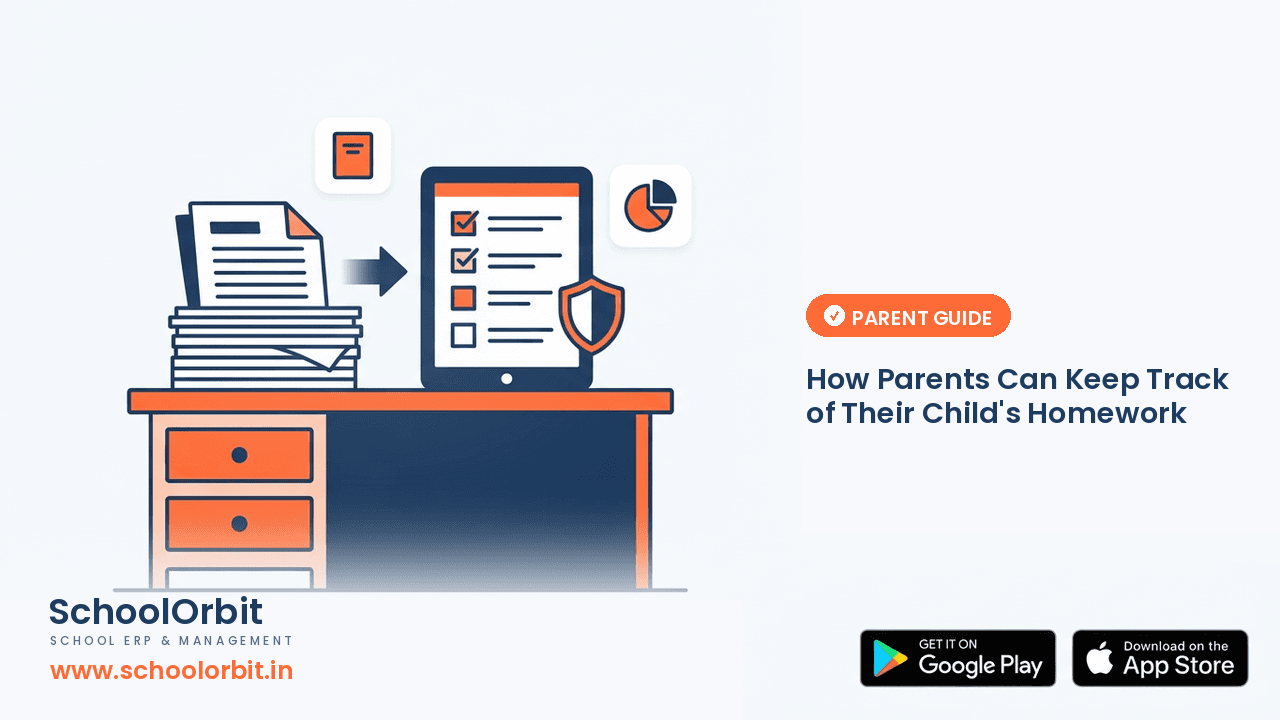
SchoolOrbit’s Homework module lets teachers share assignments with the class in writing, and parents see them in the parent app alongside that day’s notices. It is the same task for every family, so there is nothing to interpret and no need to ask twice.
If homework is still shared only verbally, ask at the next parent-teacher meeting whether written homework notices or a parent app can be used. It is a small change that removes most evening confusion for every family.
A simple evening homework routine
- 1Fix a time, for example 6:30 pm, before dinner.
- 2Read the homework list together and let your child explain each task in their own words.
- 3Check the diary or app to confirm nothing is missing.
- 4Set out the work: notebook, textbook and pencil in one place.
- 5Agree on a finish point. If a task is taking far too long, note it and tell the teacher.
A routine works better than a reminder because your child begins to expect it. After a few weeks the check takes two minutes instead of twenty.
When homework looks like too much
Sometimes the problem is not missed homework but too much of it. If your child is regularly working past a reasonable bedtime, that is worth raising with the class teacher, calmly and with an example.
Note the date, the subject and how long it took for two or three days. That kind of detail helps a teacher far more than a general complaint, and it is easier to act on.
What really matters
You do not have to teach the homework or check every answer. Your job is to make sure it reaches home, that your child understands what is being asked, and that there is a calm stretch of time to do it.
Written homework shared through the school app, one fixed evening check, and a short conversation about each task solve most of it.
- Parent App Guide
- How Teachers Assign and Track Daily Homework
- Why WhatsApp Groups Fail for Homework and Notices
- How Parents Prepare for a School PTM
Keep homework and notices in one place
With SchoolOrbit, teachers share homework in writing and parents see it in the app, in the language they are comfortable with.
Important Note
The information in this article is provided for general informational and educational purposes only. It is not legal, financial, regulatory or professional advice, and it should not be relied on as a substitute for consulting qualified professionals or your own advisers.
SchoolOrbit is an independent software provider. We are not affiliated with, endorsed by, or acting on behalf of CBSE, CISCE, any State Board, or any government or regulatory authority, and nothing in this article represents the views of any such body.
Board rules, examination policies, fee regulations and government schemes change from time to time. Always confirm current requirements with the official source — for example cbse.gov.in, cisce.org, your State Education Department, or the relevant government portal — before acting on anything you read here.
Feature descriptions refer to SchoolOrbit’s own software. We do not guarantee any specific outcome, saving or result.
Found an error? Email us at info@schoolorbit.in and we will correct it. See also our Terms and Privacy Policy.