School Fee Management System: Automating Collection, Receipts, and Reconciliation
Introduction: The Administrative Reality of School Fee Collection
In India's education ecosystem, fee collection is the financial lifeline that sustains institutional operations, infrastructure, teacher salaries, and learning facilities. According to official UDISE+ data, India has 3,41,689 private unaided schools serving millions of students across CBSE, ICSE/CISCE, and State Boards. For the management and administrative teams in these institutions, the first ten days of every quarter or month often present a recurring operational bottleneck.
Traditional fee collection methods involve long physical queues at school counters, high cash-handling liabilities, manual verification of handwritten cheques, and endless hours spent cross-referencing bank passbooks against student roll registers. A dedicated school fee management system transforms this fragmented workflow into a centralized, transparent, and automated financial operation.
When evaluated in the context of a wider school ERP software system, the fee module functions as the core transactional engine. This guide examines how Indian private schools can structure fee heads, automate online collections, enforce transparent concession rules, and simplify audit-ready bank reconciliation.
Key Challenges in Manual and Spreadsheet-Based School Accounting
Many private schools still rely on a combination of spreadsheet templates, physical receipt books, and disparate payment desktop utilities. While this approach might function for smaller preschools, it quickly breaks down as student enrollment grows past a few hundred learners:
- ✓Administrative Bottlenecks and Counter Congestion: Parents are forced to take time off work to stand in lines at the school fee counter, leading to frustration and high operational stress for office personnel.
- ✓Reconciliation Delays: When parents transfer funds via direct NEFT, IMPS, or UPI transfers into the school's bank account without typing the student's admission number in the payment remarks, school accountants spend weeks identifying whose fee was actually paid.
- ✓Complex Fee Structures: Calculating different fee heads—such as tuition fees, computer charges, sports funds, annual developmental charges, and tiered transport distance slabs—across multiple classes and streams easily results in human calculation errors.
- ✓Managing Sibling Concessions and Scholarships: Tracking family relationships manually to apply second-child concessions or staff discounts frequently leads to missed adjustments or unapproved fee waivers.
- ✓Awkward Debt Collection: School administrators often have to make uncomfortable manual phone calls to follow up on overdue fees, which strains the school-parent relationship.
Core Functional Pillars of a Modern School Fee Management System
An enterprise-grade fee management system must address both the administrative complexity of the school office and the convenience expected by modern Indian parents. When evaluating solutions, administrators should look for six core capabilities:
1. Dynamic Fee Structures and Fee Groups
Every Indian school operates on a nuanced pricing matrix. A high school student taking science stream electives with specialized laboratory facilities has a different fee structure than a primary section student. A flexible system allows administrative teams to define granular fee heads and organize them into standardized fee groups and schedules.
2. Automated Digital Invoicing and Instant Receipts
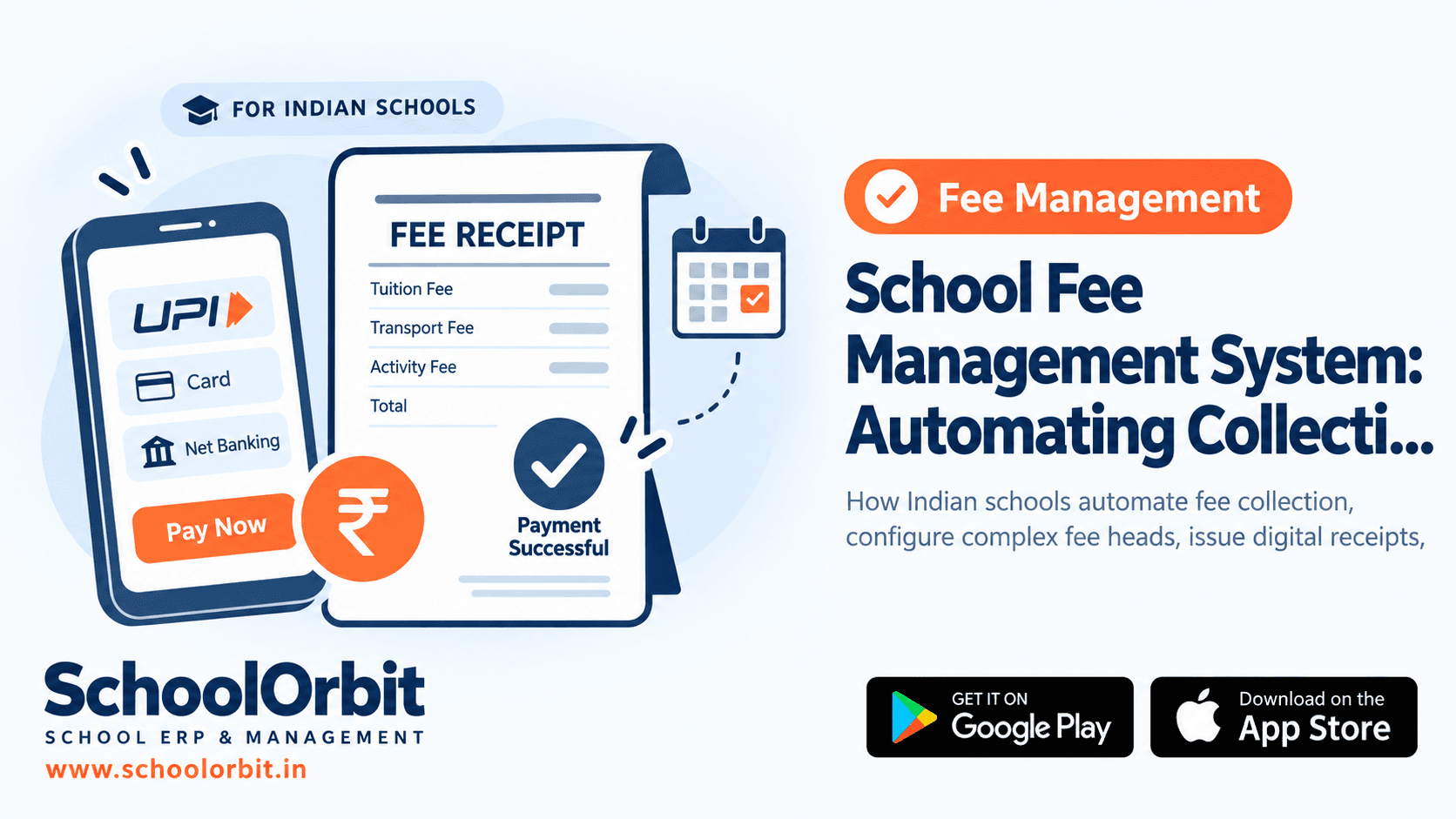
Instead of manually writing three-part paper receipts (one for the parent, one for the class teacher, and one for the accounts department), the system automatically compiles upcoming dues into detailed itemised student invoices. Upon successful transaction processing, an authenticated digital receipt featuring an unalterable sequential serial number, school affiliation details, and a scannable verification code is generated instantly.
3. Seamless Multi-Channel Online Payment Integration
With the widespread adoption of digital transactions across Indian cities and towns, parents expect friction-free payment methods. A robust school fee management platform integrates with leading Indian payment aggregators to offer:
- ✓Instant UPI Collections: Zero-friction payment through popular UPI applications without entering complex card numbers.
- ✓Net Banking and Debit/Credit Cards: Comprehensive support for all major scheduled commercial banks in India.
- ✓Auto-Generated Payment Links: Contextual SMS and WhatsApp payment links sent directly to registered parent mobile numbers prior to due dates.
- ✓Automated Payment Webhooks: Immediate server-to-server confirmation that updates the student's ledger balance in real time.
4. Automated Concession, Scholarship, and Fine Rules
Handling concessions manually introduces substantial financial risk. A specialized fee system enables administrators to establish system-enforced concession policies:
5. Automated Parent Reminders and Notices
Clear, courteous communication prevents outstanding defaults before they occur. Rather than relying on paper circulars slipped into student school bags, administrators can schedule automated digital reminders and announcements via push notifications, SMS, and WhatsApp.
6. Comprehensive Bank Reconciliation and Accounting Export
The daily reconciliation process is where school accountants save the greatest amount of time. An enterprise fee management platform produces detailed daily collection registers, cashier day-books, and head-wise ledger summaries. Furthermore, clean data export formats enable straightforward journal voucher synchronization with accounting software such as Tally or Busy, ensuring that school balances, cash-in-hand, and bank-in-transit accounts reflect accurate balances at all times.
Regulatory Compliance and Financial Governance for Indian Schools
Managing institutional finances requires strict adherence to state and national statutory guidelines. School leadership must ensure that their software aligns with operational standards:
- ✓State Fee Regulatory Guidelines: Several states have put fee-regulation legislation in place and set up committees that oversee private unaided school fee increases, admission fee norms and transparency requirements. The rules, and the body that administers them, differ by state, so confirm the position for your own state. A digital system ensures that fee notifications, published schedules, and parent communication remain transparent, audit-ready, and fully aligned with statutory norms.
- ✓GST Exemption Compliance: Services provided by an educational institution to its students, faculty and staff are exempt from GST under Sl. No. 66 of Notification No. 12/2017-Central Tax (Rate), dated 28 June 2017. The test is the nature of the education — pre-school through higher secondary, or a curriculum leading to a qualification recognised by law — not board affiliation. A well-architected fee management system separates exempt educational fees from taxable supplies, such as vendor-managed merchandise or third-party services, to preserve tax clarity.
- ✓Role-Based Financial Security: Financial data must be protected against internal manipulation. Implementing strict role-based administrative permissions guarantees that cashiers can only record counter collections, while fee head modifications, refund approvals, and discretionary waivers require explicit two-tier authorization from the principal or bursar.
How SchoolOrbit Powers School Fee Management
SchoolOrbit provides Indian schools with an enterprise-grade financial management suite designed specifically for the operational demands of K-12 institutions. Built to serve school management, administrative accountants, and parents seamlessly, SchoolOrbit's fee module delivers:
- ✓Configurable Fee Schedules: Set up class-wise, quota-wise, and stream-wise fee structures in minutes with full support for termly, quarterly, and customized payment cycles.
- ✓Integrated Parent Payments: Enable parents to view pending invoices and clear dues securely through the intuitive parent mobile application and web portal.
- ✓Instant Digital Receipts: Generate branded receipts carrying the institution's logo and a transaction identifier.
- ✓Real-Time Analytics Dashboards: Provide school directors and principals with live visibility into projected revenue, collected amounts, outstanding balances, and defalcation alerts across all grades.
- ✓Zero Reconciliation Friction: Direct gateway settlement mapping ensures every online rupee matches an authenticated admission record without manual intervention.
Explore SchoolOrbit's comprehensive operational capabilities on our features overview, review transparent pricing models on our pricing page, or schedule an interactive walkthrough on our demo request page.
Implementation Checklist: Migrating to an Automated Fee System
To roll out an automated fee management system smoothly without disrupting ongoing collections, school leadership should follow a structured four-stage rollout:
- 1Audit Master Fee Heads: Review existing fee structures across all classes. Rationalize redundant fee heads and document all approved concession categories before configuring the software.
- 2Cleanse Student Master Records: Verify student admission numbers, parent mobile numbers, sibling relationships, and assigned transport routes to prevent invoicing inaccuracies.
- 3Pilot Parallel Testing: During the mid-term or before the start of a new academic session, run the automated fee system in parallel with existing counter workflows for one payment cycle to validate bank settlement mapping.
- 4Onboard and Educate Parents: Issue clear digital circulars with step-by-step visual guides demonstrating how parents can access the portal, review invoices, pay online, and download receipts.
By replacing manual paperwork with automated precision, school administrators safeguard their institution's financial health while delivering the seamless digital experience that today's parents expect.
See it working on your own data
Put this to work on your school's own fee structure, classes and report card format.
Important Note
The information in this article is provided for general informational and educational purposes only. It is not legal, financial, regulatory or professional advice, and it should not be relied on as a substitute for consulting qualified professionals or your own advisers.
SchoolOrbit is an independent software provider. We are not affiliated with, endorsed by, or acting on behalf of CBSE, CISCE, any State Board, or any government or regulatory authority, and nothing in this article represents the views of any such body.
Board rules, examination policies, fee regulations and government schemes change from time to time. Always confirm current requirements with the official source — for example cbse.gov.in, cisce.org, your State Education Department, or the relevant government portal — before acting on anything you read here.
Feature descriptions refer to SchoolOrbit’s own software. We do not guarantee any specific outcome, saving or result.
Found an error? Email us at info@schoolorbit.in and we will correct it. See also our Terms and Privacy Policy.