Student Transfer Certificate (TC) and Records Management: CBSE Guidelines, Digital Issuance, and Verification
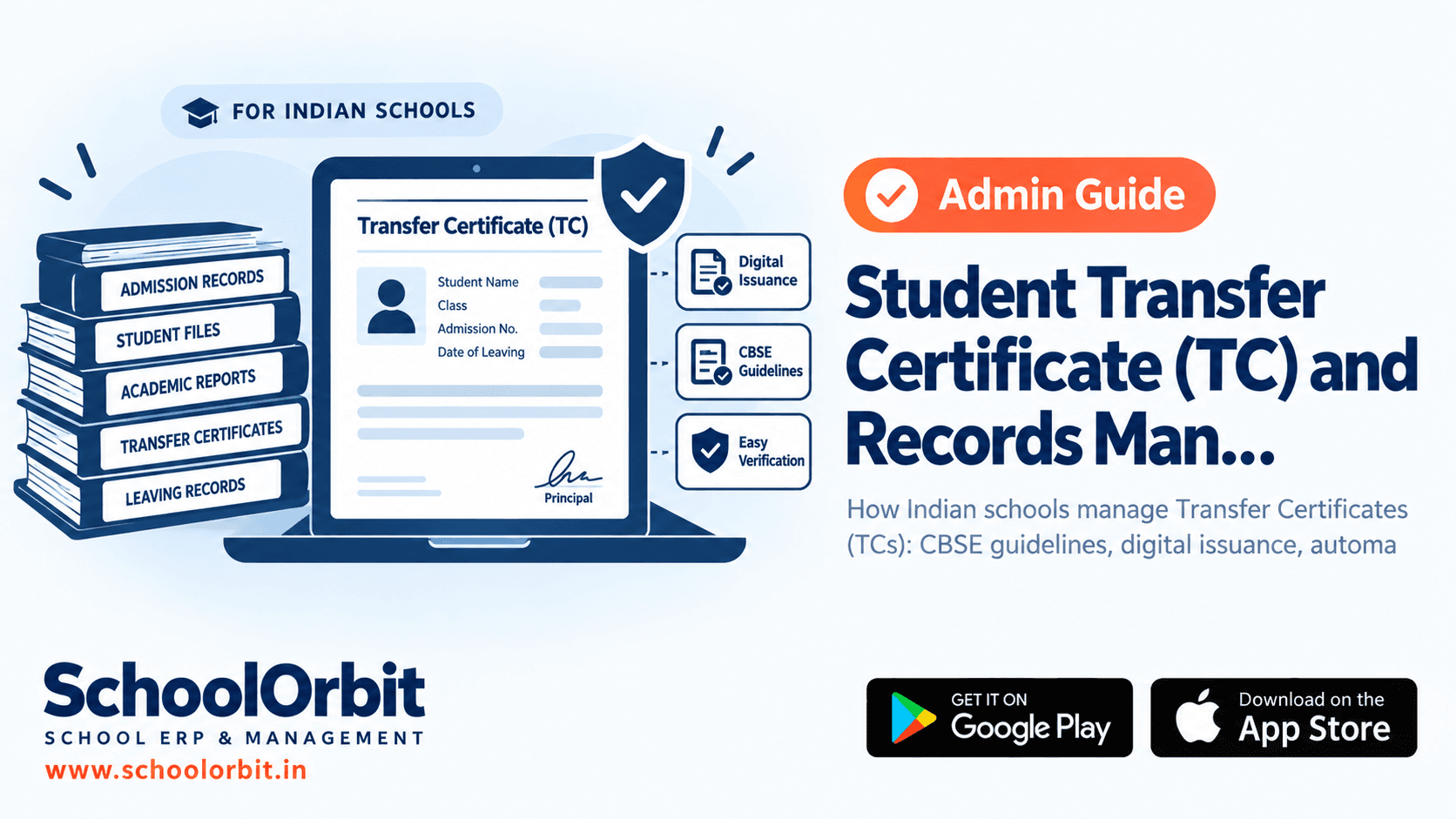
Managing student withdrawals, interstate relocations, and Transfer Certificate (TC) issuance is a critical statutory responsibility for Indian school administrators. Ensuring multi-department fee clearance, maintaining permanent scholar records, and publishing verifiable TCs online requires a reliable, automated administrative workflow.
Source: UDISE+ 2025-26, Department of School Education & Literacy, Ministry of Education.
The Regulatory Context for School Transfer Certificates in India
In the Indian schooling system, the Transfer Certificate (often termed a School Leaving Certificate) is the primary legal document certifying a pupil's academic record, conduct, and eligibility when moving between institutions or education boards. Whether a family relocates due to an employment transfer or a student completes the highest class offered by a school, issuing an accurate and timely TC is an essential administrative duty.
For CBSE-affiliated schools, regulatory guidelines mandate that issued Transfer Certificates must follow standard serial numbering formats and be uploaded to the school's public website. This transparency measure enables receiving schools and education authorities to verify the document's authenticity, preventing fraudulent admissions and duplicate enrollments.
Sequential Serial Numbering
Every Transfer Certificate must carry a unique, unbroken serial number recorded in the school's permanent admission and withdrawal register (Scholar Register).
Public Web Verification
Board directives require schools to provide an online portal or web page where parents and admissions officers can verify issued TCs against the school's official records.
Permanent Education Number Alignment
Under national digital education initiatives including UDISE+, student records and TCs link directly to the student's Permanent Education Number (PEN) for seamless tracking across states.
Statutory Record Retention
State education codes require schools to preserve student admission registers and withdrawal records indefinitely as permanent legal archives.
Manual Paper TC Issuance vs. Integrated Digital Records Management
Traditional paper-based withdrawal procedures cause substantial administrative friction, requiring parents to visit multiple school offices over several days to obtain manual signatures. An integrated ERP streamlines the entire lifecycle.
| Process Step | Manual Paper Procedure | Integrated Digital ERP Workflow |
|---|---|---|
| Withdrawal Request | Parent writes physical letters; tracking application status requires in-person visits. | Submitted online via parent portal or logged digitally at the front office with tracking. |
| No-Dues Clearance | Parent carries a paper clearance slip between library, lab, transport, and accounts desks. | Automated 1-click digital sign-off across accounts, library, laboratories, and transport. |
| Fee & Fine Settlement | Manual audit of paper ledger cards prone to overlooked late fees or pending bus charges. | Real-time invoice calculation verifies total fee clearance and generates final receipts. |
| Document Generation | Clerk manually types or writes TC counterfoils; risk of clerical typos in names or DOB. | Auto-populated directly from verified student master records; zero transcription errors. |
| Public Verification Upload | Staff scan paper certificates, manually rename PDFs, and upload to the school website. | Instantly publishes verifiable digital record to the school's public TC search portal. |
The 5-Stage Digital Student Withdrawal and TC Workflow
Implementing a structured digital workflow ensures complete compliance while eliminating delays for departing families:
- 1Formal Application Logging: The withdrawal request is logged into the school ERP, capturing the formal reason for leaving, destination school details, and requested leaving date.
- 2Automated Multi-Department 'No Dues' Clearance: The system automatically verifies that library books have been returned, science/computer equipment accounted for, transport fees settled, and tuition dues cleared.
- 3Administrative Review & Conduct Verification: The class teacher and principal verify academic progress, attendance records in the classes held, and general conduct remarks.
- 4Digital Certificate Generation & Serial Allocation: The ERP generates the official Transfer Certificate using the board-prescribed format, stamping a sequential serial number and verified student credentials.
- 5Public Portal Publication & Archiving: The signed document is published to the school's online TC verification directory and permanently archived in the digital General Register.
While schools must settle outstanding tuition and transport invoices prior to withdrawal, administrative clarity and proactive parent communication prevent dispute escalations. Maintaining transparent digital account statements ensures fair, undisputed settlements before certificate issuance.
Key Data Elements Required in an Official Transfer Certificate
To ensure compliance with board verification standards, an official Transfer Certificate must precisely capture the following verified fields from the student's master file:
- ✓Student & Parent Identification: Pupil's full legal name, mother's name, father's/guardian's name, and nationality matching original birth certificate and admission documentation.
- ✓Admission & Category Details: Original date of admission, class into which admitted, admission/scholar number, and whether the student belongs to SC, ST, or OBC categories.
- ✓Date of Birth: Exact date of birth stated both in figures and in words as verified during initial school enrolment.
- ✓Academic & Examination Record: Class in which the pupil last studied, school or board annual examination results, and whether the student was qualified for promotion to a higher class.
- ✓Session Attendance Record: Attendance in the classes held during the current academic session up to the formal date of leaving.
- ✓Fee Clearance & Concessions: Explicit certification that the student has paid all school dues, along with details of any fee concessions received.
- ✓General Conduct & Reason for Leaving: Objective appraisal of student conduct and the specific reason cited for withdrawal (such as parent transfer or family relocation).
Preserving the School's Digital Scholar Register
Under state education department rules, the General Register (Scholar Register) is a permanent legal record. School administrators are required to safeguard these entries across decades to verify historical student credentials, support duplicate TC requests, and assist alumni verification.
Permanent Cloud Archiving
Historical student records, original admission documents, and issued TC copies remain securely stored and instantly searchable by admission number, name, or academic session.
Alumni & Duplicate TC Support
When past students request duplicate certificates or record verifications decades later, the administrative office can retrieve verified master files in seconds without searching dusty store rooms.
Audit-Ready Board Compliance
During board inspections or affiliation renewals, digital scholar registers provide immediate verification of admission serial numbers, student promotions, and withdrawal records.
Learn more about managing student lifecycles and administrative records in SchoolOrbit:
Streamline Student Withdrawals and TC Issuance
Discover how SchoolOrbit simplifies no-dues clearance, automates verifiable TC generation, and preserves permanent student records effortlessly.
Important Note
The information in this article is provided for general informational and educational purposes only. It is not legal, financial, regulatory or professional advice, and it should not be relied on as a substitute for consulting qualified professionals or your own advisers.
SchoolOrbit is an independent software provider. We are not affiliated with, endorsed by, or acting on behalf of CBSE, CISCE, any State Board, or any government or regulatory authority, and nothing in this article represents the views of any such body.
Board rules, examination policies, fee regulations and government schemes change from time to time. Always confirm current requirements with the official source — for example cbse.gov.in, cisce.org, your State Education Department, or the relevant government portal — before acting on anything you read here.
Feature descriptions refer to SchoolOrbit’s own software. We do not guarantee any specific outcome, saving or result.
Found an error? Email us at info@schoolorbit.in and we will correct it. See also our Terms and Privacy Policy.
Tags